
How to Clean a Squishmallow Pet Bed Without Ruining the Fill
Squishmallow pet beds are spot-clean only — the plush fill is not machine-washable. This guide covers safe cleaning methods, drying tips, and how to keep your pet’s bed fresh long-term.
Last reviewed: | Reviewed by: John Paul
Disclosure: This page contains affiliate links. We may earn a commission from Amazon purchases made through our links at no extra cost to you.
How to wash a Squishmallow pet bed: Squishmallow pet beds are spot-clean only — the EF polyester fill and plush shell are not designed for machine washing or full submersion in water. To clean, dampen a cloth with cool water and mild soap, gently blot the soiled area, then allow the bed to air dry completely before your pet uses it again. Cave designs like Cam and Fifi require separate attention to the interior hood to prevent moisture buildup.
Every Squishmallow pet bed in the Jazwares lineup — from the 16-inch cave designs to the 30-inch Archie axolotl — uses the same EF (Extremely Fluffy) polyester fill and plush exterior shell. That shared construction means one shared care rule applies across the entire full Squishmallow pet bed lineup: spot cleaning only. This guide covers everything you need to know about why machine washing is not an option, which cleaning products are safe, how to carry out a proper spot clean on both open and cave-style designs, and how to dry the bed correctly after cleaning. You can also use the size guide for choosing the right bed to check whether the bed you are cleaning is the correct size for your pet before you buy a replacement.
Why the EF Polyester Fill in Squishmallow Pet Beds Cannot Survive Machine Washing
The EF (Extremely Fluffy) polyester fill used in every Squishmallow pet bed is the defining feature of the product — it is what gives the beds their signature loft, softness, and cushioning character. However, that same fill specification makes machine washing genuinely destructive, not merely inadvisable.
When a Squishmallow bed is submerged in water — whether in a washing machine or a sink — the EF polyester fill absorbs water very heavily. Unlike conventional memory foam or tightly woven polyfill that repels water from its surface, EF fill is loose and open-structured, meaning water penetrates all the way through the casing into the fill itself. The fill then holds that water weight, causing it to compress downward and shift within the casing during the wash cycle’s agitation phase.
Machine agitation, even on a gentle or delicate cycle, physically displaces the fill from one area of the casing to another. Once clumped and shifted, EF polyester fill does not redistribute evenly on its own after washing. The result is a bed that is flat in some areas and bunched in others — a structural failure that cannot be reversed by hand-fluffing.
The heat from a tumble dryer compounds the problem. Synthetic polyester fill fibres lose their memory and crimp structure when exposed to dryer-level heat, causing the material to mat permanently into a dense, flat layer instead of the loose, lofted structure that gives the bed its cushioning. The plush exterior shell simultaneously loses its raised texture under dryer heat, becoming flat and rough.
Jazwares and Kellytoy care guidelines across the entire Squishmallow product range — including both the plush toys and the pet beds — consistently state spot clean only. This is not a conservative recommendation — it is the correct and only safe care method for this fill type.
What Cleaning Supplies Are Safe to Use on Squishmallow Plush Fabric
Safe cleaning supplies for Squishmallow pet beds are limited to those that can be applied in small, targeted amounts and removed without saturating the fill beneath the plush exterior. The correct materials are those that clean the surface without driving moisture deep into the casing.
Safe supplies include: a clean microfibre cloth or soft cotton cloth (dampened, not soaking wet), cool or lukewarm water, a small amount of mild liquid dish soap (a few drops mixed into a cup of water is sufficient), a pet-safe liquid detergent diluted to a very low concentration, and dry baking soda used as an odour-neutralising powder applied to the surface and then brushed away without water. A second dry cloth or clean dry towel for blotting residue is also useful.
Supplies that must never be used on a Squishmallow pet bed include bleach in any dilution (degrades synthetic fibres and discolours the plush), hydrogen peroxide (oxidises and bleaches coloured plush material), hot water (causes both fill compression and plush texture loss), commercial fabric softener spray (leaves residue that attracts dirt and can irritate pet skin), and steam cleaners directed at the fill zone (forces pressurised moisture deep into the casing, replicating the machine-wash problem). Paper towels should also be avoided during the blotting stage — they shed small paper fibres into the plush surface that are difficult to remove.
Step-by-Step Spot Cleaning Method for Open Squishmallow Bed Designs
Open-round designs — including the Gordon shark 24-inch bed, the Wendy frog 20-inch bed, and the Archie axolotl 30-inch bed — use the same spot-cleaning steps described below.
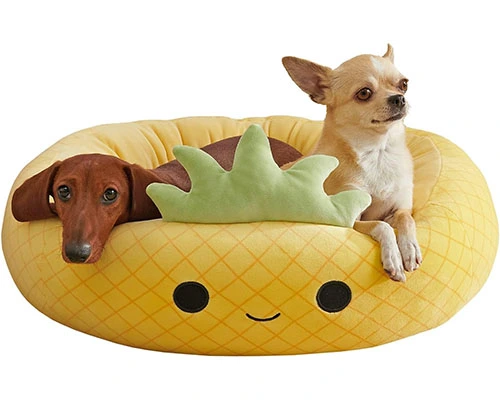
The open-round designs — Gordon and Maui and Tatiana (24-inch), Wendy, Beula, and Cici (20-inch), and Archie (30-inch) — all share the same flat, open-platform construction, which makes spot cleaning straightforward. The entire sleeping surface is accessible from above, there are no enclosed spaces, and moisture that is introduced carefully does not easily reach the fill if you keep the cloth damp rather than wet.
Follow these steps in order:
Step 1 — Remove loose debris. Take the bed outside or over a waste bin and shake it firmly to dislodge loose pet hair, dander, dirt, and debris. Do not skip this step — wet cleaning over loose debris simply pushes the particles deeper into the plush fibres.
Step 2 — Prepare the cleaning cloth. Dampen a clean microfibre cloth under cool running water. Wring it out firmly until it is damp to the touch but not dripping. A cloth that releases drops of water when squeezed is too wet for this use.
Step 3 — Add a small amount of mild soap. Place 2 to 3 drops of mild dish soap onto the damp cloth and work it into the cloth fabric with your fingers until evenly distributed. Do not apply soap directly to the bed.
Step 4 — Blot the stained area. Press the cloth firmly onto the soiled area and lift — do not scrub or rub in a circular motion. Scrubbing spreads the stain outward and pushes it deeper into the plush pile. Repeat the blotting motion, repositioning the cloth to a clean area each time, until the visible stain has lifted.
Step 5 — Rinse with a clean water cloth. Dampen a second clean cloth with cool water only (no soap). Blot the cleaned area to remove soap residue. Soap left in the plush attracts new dirt and can irritate pet skin.
Step 6 — Blot dry. Press a dry towel or thick dry cloth firmly over the cleaned area for 30 to 60 seconds to absorb as much surface moisture as possible before the air-drying phase begins.
Step 7 — Air dry flat. Lay the bed flat in a well-ventilated area away from direct heat sources. Do not fold or stack the bed while it is damp — folding compresses the fill and encourages uneven drying.
How to Clean the Interior Hood on Cave-Style Squishmallow Beds Without Trapping Moisture
The Cam cat cave interior cleaning and hood-drying protocol and the Fifi fox cave hood moisture prevention and drying protocol are the two 16-inch cave-style designs in the Squishmallow pet bed lineup. Both feature an enclosed hood structure that creates a domed sleeping space over a portion of the bed. This hood is what makes the cave design appealing to pets that prefer enclosed sleeping environments — but it also makes cleaning more complex.
The fundamental challenge with cave-bed cleaning is airflow. The interior of the hood has very limited ventilation. Moisture introduced into the hood — even from a damp cloth — takes significantly longer to evaporate than moisture on an open flat surface. If the hood interior is cleaned and then sealed while any moisture remains, the damp environment inside the compressed fill creates conditions that can promote mould growth over time.
The correct approach for cleaning the interior hood of Cam or Fifi is to use a cloth that is barely damp — noticeably drier than the cloth used for an open bed surface. Use a narrow cloth or a cloth folded to a smaller working surface to reach the interior curves of the hood. Blot gently — do not saturate any area. After cleaning, the hood must be held open — prop it back with a hand towel or a rolled cloth placed inside the opening — and left in a well-ventilated area until the interior is completely dry to the touch. This may take considerably longer than drying an open bed, particularly if the ambient humidity is high. Never fold the hood closed over a damp interior for any reason.
How to Dry a Squishmallow Pet Bed Fully After Spot Cleaning
Drying a Squishmallow pet bed correctly after spot cleaning is as important as the cleaning itself. A bed that is returned to your pet before it is fully dry will feel cold and uncomfortable on the sleeping surface, and repeated partial drying can eventually allow moisture to accumulate in the fill over multiple cleaning cycles.
Air drying on a flat surface or draped over a drying rack is the only appropriate drying method. Do not tumble dry — even an air-only (no heat) dryer setting involves physical tumbling that can shift and clump the EF fill in the same way a wash cycle does. Do not place the bed on or near a radiator or heating vent, and avoid prolonged exposure to direct midday sunlight — sustained high heat from external sources degrades the plush fibres over time, even without machine-level temperatures.
For surface-only stain cleaning where only the outer plush layer was dampened, the drying time is typically 2 to 4 hours in a normally ventilated indoor space. If the cleaning was more extensive and moisture may have reached the fill beneath the casing, allow 8 to 12 hours of full air drying before allowing your pet to sleep on the bed again. For cave designs with an open interior hood, err toward the longer end of that range.
Once the bed is fully dry, use your hands to work through the plush exterior and gently redistribute any fill that has shifted during handling. The EF fill should spring back into even distribution readily when the bed is dry — if it feels flat or uneven, the fill may still contain residual moisture and drying should continue.
How Often Should You Clean a Squishmallow Pet Bed
The cleaning frequency for a Squishmallow pet bed depends on how actively it is used and the habits of the pet sleeping on it. There is no single universal schedule, but several practical guidelines apply to most situations.
Spot clean immediately after any soiling accident — urine, vomit, mud, or food spills should be addressed as quickly as possible. Fresh stains that have not yet dried are significantly easier to remove without leaving residue. Waiting until a stain has dried and set makes complete removal much harder and may require more aggressive blotting that drives the cleaning cloth deeper into the plush surface.
For routine maintenance — removing accumulated pet hair, dander, light surface dirt, and general odour — a spot clean every 2 to 3 weeks is appropriate for a bed in daily active use. For a bed used by a pet that rarely has accidents and is groomed regularly, a monthly maintenance clean may be sufficient.
For odour control between cleaning sessions, dry baking soda is a useful and safe tool. Sprinkle a light layer of baking soda over the bed surface, work it gently into the plush with your fingers, leave it for 15 to 30 minutes to absorb odour-causing particles, then brush or shake it completely out of the bed. This process adds no moisture and can be done as frequently as weekly without any risk to the fill or the plush exterior.
As part of weekly visual checks, examine the bed for seam integrity (threads pulling, openings developing), fill distribution (flat spots indicating fill has shifted), and surface texture changes (pilling, matting, or rough areas that may indicate the outer material is beginning to wear).
Frequently Asked Questions About Squishmallow Pet Bed Care
Q1: Can I put a Squishmallow pet bed in the washing machine?
No. Squishmallow pet beds are spot-clean only. Machine washing causes the EF polyester fill to absorb water, clump, and shift permanently inside the casing. The plush exterior also loses its texture under machine agitation and dryer heat. Jazwares care guidelines are explicit: spot clean only on all Squishmallow pet bed designs.
Q2: How do I get dog smell out of a Squishmallow bed without washing it?
Sprinkle dry baking soda lightly over the entire sleeping surface. Work it gently into the plush with your fingers and leave it for 15 to 30 minutes. Brush or shake the baking soda completely out of the bed. Repeat weekly as needed. For persistent odour in a localised area, follow up with a targeted spot clean using a damp cloth and a small amount of mild dish soap, then air dry fully.
Q3: What happens if the Squishmallow fill gets wet?
If the EF polyester fill inside a Squishmallow bed becomes wet — from a large spill, an accident that soaks through the casing, or improper washing — it will absorb the water heavily and compress. Allow the bed to air dry completely flat for at least 24 hours in a ventilated space before use. Fluff the fill by hand through the casing while it dries. In severe cases where the fill has clumped and will not redistribute after drying, the fill distribution will be permanently compromised.
Q4: Can I use a steam cleaner on a Squishmallow pet bed?
No. A steam cleaner directed at the surface of a Squishmallow pet bed forces pressurised moisture and heat simultaneously into the fill. This replicates the worst aspects of machine washing — moisture penetration into the EF fill — combined with the heat damage of a dryer. Steam cleaning should never be used on any Squishmallow pet bed design.
Q5: How do I clean the non-slip base of a Squishmallow bed?
The non-slip base on Squishmallow pet beds can be wiped clean with a damp cloth without the same risk of moisture penetrating the fill, since the base is the underside of the casing. Wipe the base surface with a damp cloth and mild soap, then wipe again with a water-only cloth to remove soap residue. Allow to dry before placing on a floor surface.
Q6: Can I use pet stain remover spray on a Squishmallow bed?
Enzymatic pet stain removers vary in their formulation. Some contain active ingredients that are safe for synthetic plush fabric; others contain chemicals that can bleach or degrade the exterior. Before using any commercial stain remover, test it on a small, inconspicuous section of the bed and allow it to dry before assessing the result. Do not spray heavily — apply to the cloth first, not directly to the bed, and blot rather than saturate.
Q7: How long does a Squishmallow pet bed take to dry after spot cleaning?
For a surface-only spot clean where only the outer plush layer was dampened, drying time in a normally ventilated room is 2 to 4 hours. If moisture reached the fill layer, allow 8 to 12 hours of air drying before returning the bed to your pet. Cave designs (Cam, Fifi) with a damp interior hood should be left open and may take up to 12 hours or longer in humid conditions.